Search

Dual crisis in healthcare supply chain: How to prepare my hospital supply chain for disruptions

As persistent disruptions collide with rising savings pressure and unpredictable clinical alignment, leaders must balance conflicting priorities to achieve resilience and value in 2026.

symplr’s 2026 State of Healthcare Supply Chain Survey shows a real shift in sentiment

A majority of respondents (53%) expect healthcare supply chain challenges to worsen in 2026, compared to 24% who said the same about 2025. Optimism is also sliding: only 19% believe challenges will improve in 2026, down from 32% in 2025.

Many healthcare supply chain teams say they feel more disrupted, more stretched, and more accountable for savings than ever. Shortages and daily escalations are still crowding out strategy, yet teams still lack the resources, clinical alignment, or data confidence to move from reactive firefighting to true resilience.

As healthcare supply chain leaders plan for continued volatility in 2026, this playbook lays out practical steps to strengthen resilience and build the competencies needed for a more stable year ahead.​

Graphic representing 53% Expect supply chain challenges to worsen, and the sentiment around supply chain challenges are worsening
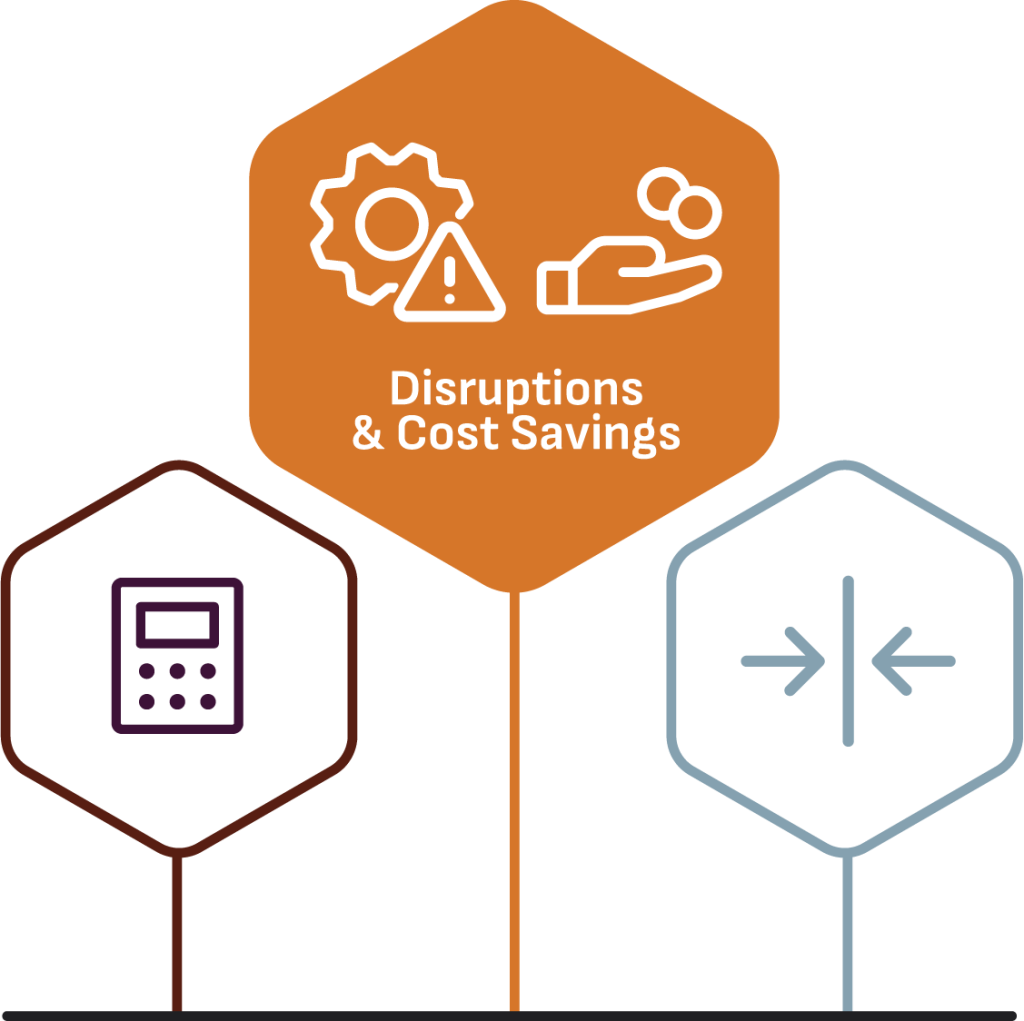
Graphic showing disruptions and cost saving tied for the top challenges

Key Healthcare Supply Chain Survey Findings

Top Healthcare Supply Chain Challenges in 2025

Disruptions and cost savings pressures share the #1 spot as healthcare supply chain’s biggest challenges, forcing leaders to juggle risk, resiliency, and aggressive savings goals simultaneously.

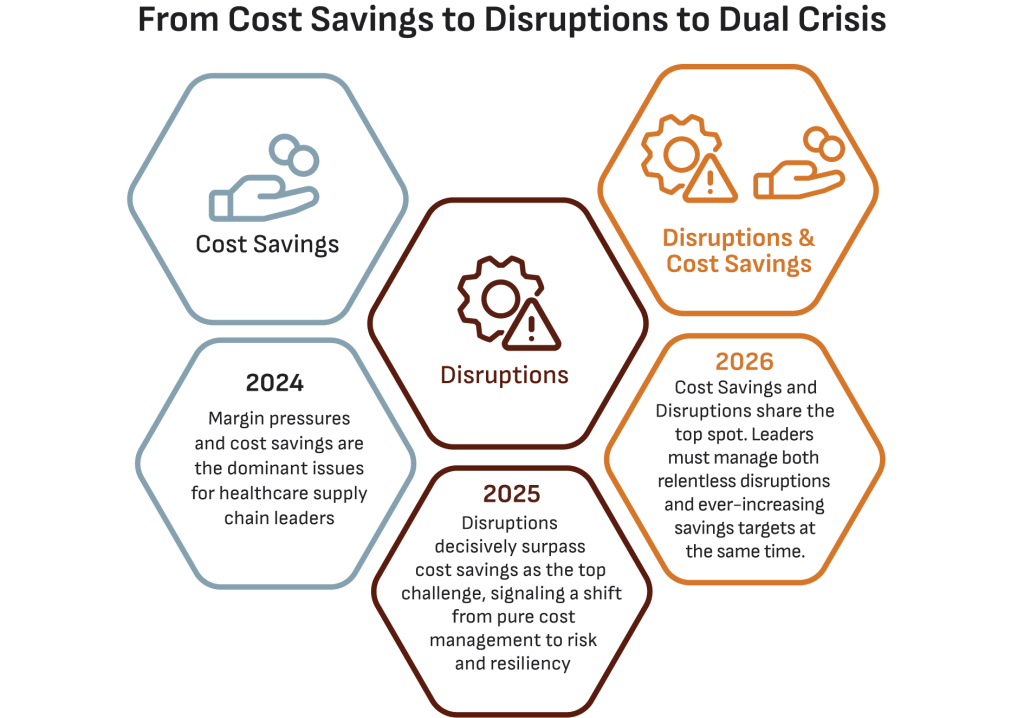
In 2024, margin pressure and cost savings dominated. In 2025, disruptions overtook cost savings as the top challenge, signaling a move toward risk management and resilience.

In 2026, leaders are dealing with both at the same time. Cost savings and disruptions now share the top priority. Healthcare supply chain teams are expected to manage volatility while still delivering measurable financial results.

What does supply chain volatility mean for hospitals in 2026?

Three clear priorities for 2026 emerged from this survey:

  1. Generating cost savings
  2. Improving patient outcomes
  3. Standardizing processes & monitoring and reducing unnecessary utilization

While cost savings are once again the top priority for 2026, patient outcomes and standardization remain nearly as important, cementing a more balanced, value-driven mandate: “Save money, standardize, and prove outcomes.”

As healthcare supply chain volatility continues, hospitals will need stronger visibility, clearer governance, and consistent operational discipline to stay ahead.

2026 SupplyChain TimelineChallenge@2x
2026 SupplyChain TheChallengesv2@2x

What are the biggest issues with medical supply chains?

Products are harder to secure and budgets are tighter — yet expectations for improvement aren’t going down.​

Disruption heat is on: Why are medical supply chains so unstable lately?

Material shortages are the leading issue, cited by 46% of respondents in the 2026 survey.

Tariffs follow at 29%, reflecting ongoing sourcing and cost pressure. Inflation accounts for 13%. Natural disasters are cited by 9%. Geopolitical conflicts represent 3%, and 1% point to other causes.

This isn’t one isolated problem. It’s layered risk hitting at the same time.

Leaders report growing concern about not having product available at all, especially for high-impact surgical and critical care procedures. Disruption has shifted from commodity PPE to more specialized products, which raises the operational and clinical stakes when shortages occur.

At the same time, tariffs and inflation continue to influence purchasing decisions. Healthcare supply chain teams are managing availability risk and financial pressure simultaneously, which helps explain why medical supply chains remain unstable in 2026.


Savings targets are rising – again…​

Despite multi-million-dollar savings in 2025, cost savings goals keep climbing year over year.

  • Almost half expect goals to increase by at least 5%
  • Only a minority expects lower savings targets due to increased spending
>5%

Cost savings goals increase

Cost savings pressure is up while disruption risk is up—Supply chain leaders must leverage utilization and standardization strategies vs. pure price negotiations.

Clinical support is moving in the wrong direction​

Clinical integration across the healthcare supply chain remains fragile. The structure may be in place, but deeper partnership between clinical and supply chain teams is under strain.

Only 32% of respondents say their healthcare supply chain is fully clinically integrated. Another 64% describe their organizations as somewhat clinically integrated — suggesting alignment exists, but depth is limited.

Perceived clinician support is declining sharply. In 2024, 19% of leaders said clinicians “strongly agree” they are supportive of supply chain activities. That rose slightly to 20% in 2025. In 2026, however, only 3% report strong clinician support — signaling widening misalignment between clinical and healthcare supply chain teams.

Leaders recognize the gap and the importance of clinical champions and outcomes data, particularly in procedural areas where product decisions directly affect both cost and patient care.

The numbers suggest that while structures exist for clinical alignment, the depth of genuine partnership is weakening — a strategic risk for any utilization or standardization effort.​

Graphic showing only 32% of respondents say their supply chain is fully clinical integrated

Teams are still stuck in firefighting mode:

This is the execution gap: It’s not that leaders don’t know what needs to be done — it’s that their teams are overwhelmed with tactical firefights.​

A sizable share of supply chain time is still consumed by day-to-day disruptions and manual work, while confidence in having enough resources, data, and clinician support is eroding.​

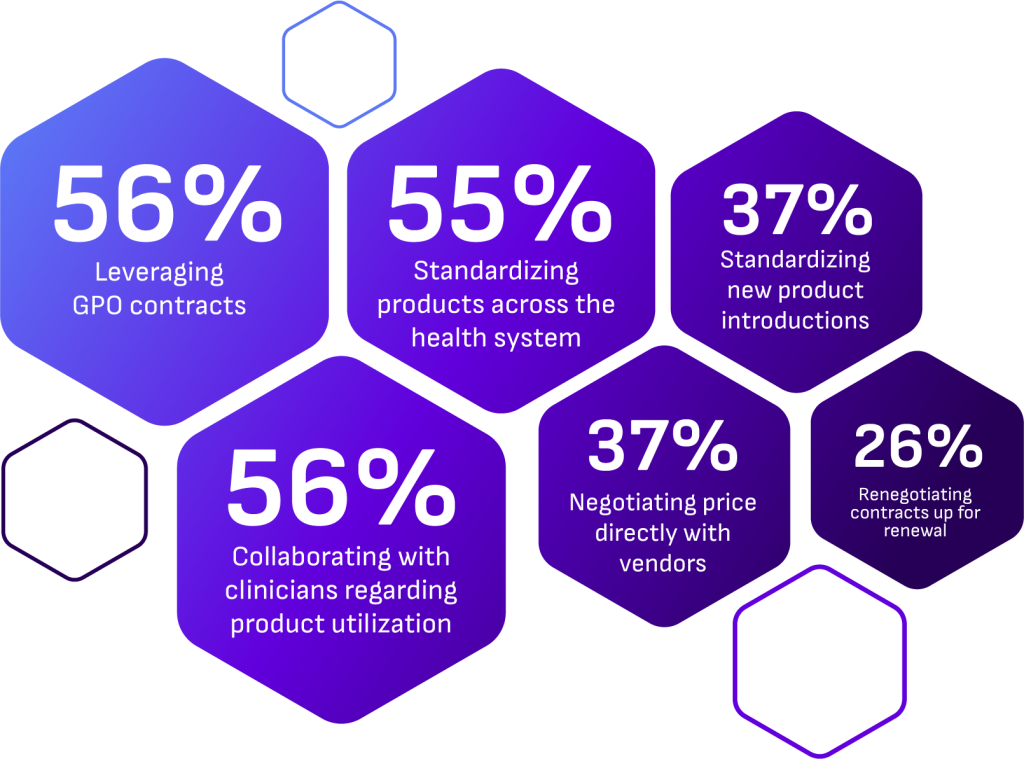
How health systems look to achieve cost savings goals in 2026
2026 SupplyChain ThePlaybook@2x

Healthcare Supply Chain Playbook 2026 

How to prepare my hospital supply chain for disruptions

Stop chasing price. ​
Standardization + clinical collaboration are the new savings engine:​

Tactics have shifted away from pure price-only plays toward :​

  • Standardization (products and processes)​
  • Stronger GPO + vendor partnerships​
  • Closer collaboration with clinicians and utilization management

Clinicians are the key to utilization-based savings: ​

  • Target procedure-level variation and preference items with clinician champions​
  • Get physician buy-in by putting outcomes + cost in front of peers, not just the unit price​
  • Bake CQO language into governance and VA forms​

Secure resiliency budgets now

Material shortages + tariff risk are your top 2026 disruptors. To tackle these you need to:​

  • Risk-stratify items by criticality first, then by velocity ​
  • Multi-source critical items ​
  • Hold strategic reserves built from reduced utilization – not just more inventory​
  • Add index-linked clauses in 2026 renegotiations​
  • Track resiliency KPIs in supplier scorecards/QBRs
2026 SupplyChain CarveBackTime@2x

Carve back strategic time.

Seventy-five percent of healthcare supply chain leaders say 30% or less of their time is spent on firefighting — a slight improvement from prior years. Still, that means a big chunk of your day is tied up in chasing shortages, price swings, and last-minute issues instead of driving long-term impact.

If you want more room for strategy, lock down the fundamentals:

  • Use clinical evidence to guide product decisions
  • Partner directly with clinicians on standardization and utilization
  • Know your real price position and total cost​​

Strategic time doesn’t magically appear. In the healthcare supply chain, you create it by reducing noise, solving root causes, and making proactive decisions before problems escalate. These steps represent high-leverage behaviors that free teams from tactical firefighting — but require consistent process support to sustain.​

Related resources

Infographic

Top Challenges Supply Chain

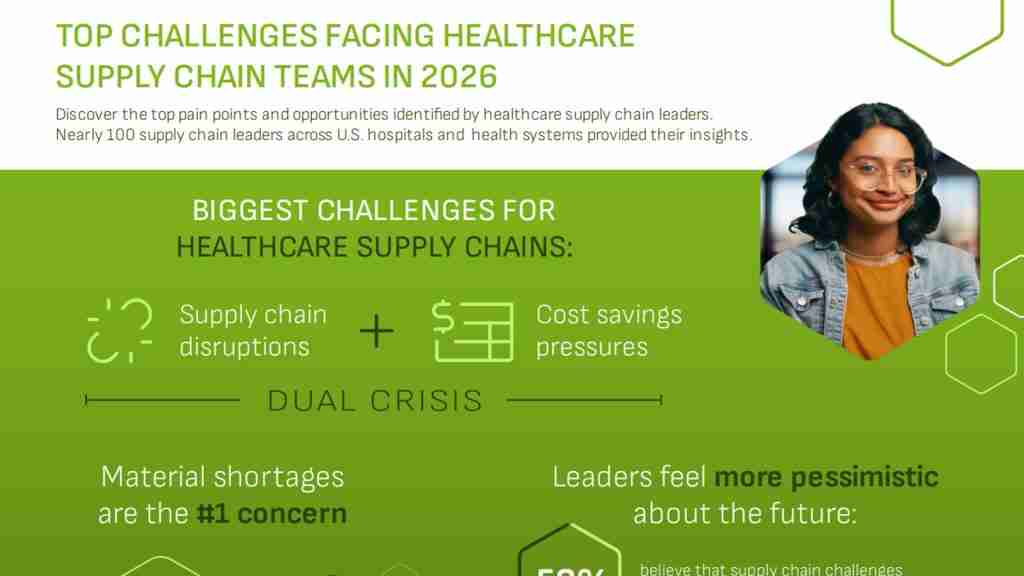
Top Challenges Facing Healthcare Supply Chain Teams in 2026

Blog

Hospital supplies

2026 State of Healthcare Supply Chain: What This Year’s Results Tell Us About the Road Ahead

Customer Story

Value analysis case study

Health First & Nebraska Methodist: A Blueprint for Value Analysis Excellence

Related products

symplr Value Analysis

Build evidence-driven standardization with clinician visibility

symplr Spend Analysis

Drive smarter cost decisions beyond price negotiations​

symplr Contract

Embed resiliency and supplier risk terms strategically​